Posts

New urban development leading towards unsustainable consumptive lifestyles
Image
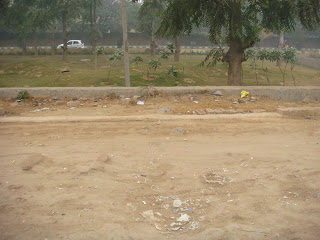
Last week, I had a chance to visit and stay in Gurgaon, a new face of suburbia in India. I was appalled at the chaos that is Gurgoan. I had heard about the glitz and glamour of the city. The NH8 that connects Gurgaon to Delhi is lined with tall glass facade buildings, showing prominent corporate brands on their faces. The NH8 itself is a multiple lane freeway, where cars speed to and fro between Delhi and Gurgaon, carrying in them elite business class of India, churning wealth and pouring money into the country's economy. While this is happening at one end, where the private sector is complacent in its own wealth, the roads and the urban infrastructure is terrible. The minute you step out of your own glass building and stand on the road, you see a high speed vehicle access but no place to walk! Footpaths are not only non existent, its extremely unsafe to walk along the road sides at dusk. The dusty landscape of this region spills on to the new roads, so the road sides are sand fill...

COP 15 - Copenhagen Climate Change Conference: A new beginning for change?

Since the past two days I have been interacting with people talking about the Copenhagen Conference to be held in December 2009. Its quite interesting, I thought, that the media has made the jargon accessible and I find words like Climate Change and even Kyoto Protocol being used everywhere. After hearing these words being mouthed by some most improbable people, I was motivated enough to look up the Copenhagen Conference. And here I am sharing a few snippets of information that I managed to garner. Here goes.... What is it that the world is looking forward to from the Copenhagen Conference? Though, quite ambitious in itself, this conference 'merely' aims to bring clarity on the action towards Climate Change that the major economies of the world will take up. This is what the UN Exec Secretary of (United Nations Framework Convention on Climate Change (UNFCCC), Mr Yvo de Boer aims to achieve at the least. He speaks about bringing clarity on four essentials for collective Interna...

Nuclear Power for India at the cost of Environment?

A few days back, I and my students had a chance to interact with a Nuclear Physicist. The pertinent question that all of us had on our minds and came out in our discussions was Would Nuclear Power mean a boon or a curse for India? Nuclear Power is amazing! In a nutshell, it takes just a little radioactive substance to be 'processed' in a Nuclear Power reactor and the whole substance with its looooong half life, takes its own sweet time to divide itself into smaller and smaller particles, producing large amounts of heat and thereby power for India. Sounds simple, isn't it? However its not so! The underlying political, administrative and technical processes finally will define how the nuclear power gets generatedand used. The N-Deal that was publicized by the media and politically negotiated by our Prime Minister simply states that we can now import Nuclear fuel for power generation in our country. The technical negotiations will now begin to fire up existing nuclear reactors...

To Build or Not to Build on Hills . . .

. . . And that is the classic question that Punekars have been asking since the last 10 years. Frankly, I have been unable to take either side. At one end I know that the remaining 'open' space will disappear surely if permissions are given to build on the hill tops and hill slopes. At the other end, I am not sure if Pune, via its municipal corporation, has the capacity to develop hill tops and hill slopes as natural preserves for biodiversity. Is there a middle way? I often ask myself. What is it that it prompting activists to react on one end, while the municipal government is pressured to act on the other end? Is it just the developers lobby seeking more core city land to build premium condos and earn money that is pressurizing action against biodiversity preservation or are their other forces at play too? When in San Francisco, I had a chance to look at a hilly and completely contoured terrain of California being developed as breautiful city suburbs, which led me to thinkin...

Architecture for (Social) Responsibility

Image
In my explorations of San Francisco, I came across a very innovative architectural exhibition. This was organized by American Institute for Architects, SF Chapter. The idea of the exhibition was to commend six architectural not-for-profit organizations and their contributions to Social Architecture. These visionaries have shaped the urban landscape by designing affordable housing for the poorest San Franciscans (Asian Neighborhood Design); rebuilt Sri Lankan villages devastated by tsunamis (Architecture for Humanity); challenged our assumptions about the use of urban parking spaces (Rebar); plowed up urban sidewalks and created wildflower gardens (PlantSF); educated kids about careers in architecture (Architectural Foundation of San Francisco); and reshaped the possibilities of pro bono (voluntary without pay) service in the architecture profession (Public Architecture). The innovative designs were amazing to see. The most simple one that I liked and I feel made a difference in our eve...

10 x 10 Cities of US - An Environmental Cities Comparative Exhibition in San Francisco

Image
In April 2009, the American Institute of Architects (AIA) had their annual convention in San Francisco. Under the umbrella of this event and in partnership with various orgnizations, a small exhibition was organized titled as '10 x 10 cities - Green Facts Challenges Futures. The exhibits were organized as datascapes showing the current challenges facing the 10 major North American cities, including San Francisco. The interesting part of the exhibition was the responses to these challenges by architects in terms of their green designs and planning of energy efficient buildings. The exhibition also showcased San Francisco's Environmental Action Plan aiming towards its Climate Change goals. The interesting and perhaps unique point about this exhibit was the effective use of visual language used in communicating green facts about cities. The 10 cities were compared on a 10 point Sustainability Scale, which included parameters such as garbage production, water consumption, air quali...

Renewable Energy . . . Still a Dream for SF

Image